Swatch x Omega Solar Eclipse MoonSwatch Marks A One-Day Moment In Spain
Swatch x Omega Mission to the Sun Solar Eclipse Was Here for Just One Day
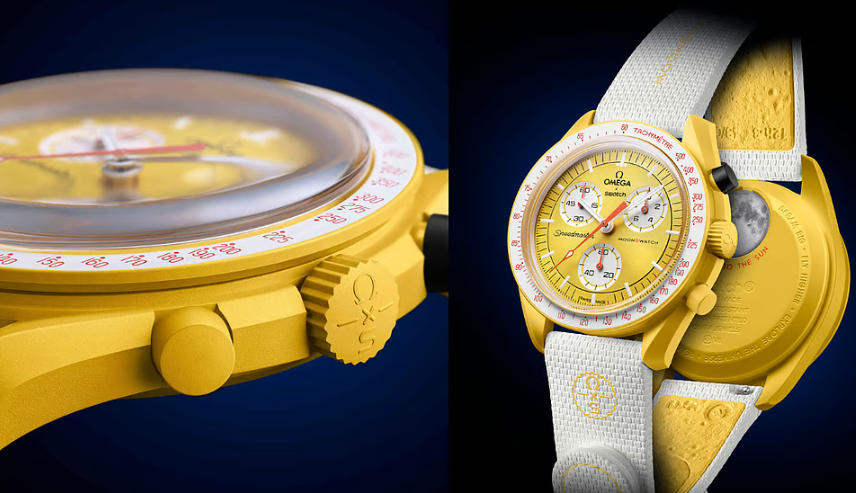
Most MoonSwatch releases arrive with a fairly obvious hook. Some introduce a new colour, others play with a familiar Speedmaster detail, and a few are built almost entirely around the story of the day on which they appear. The Mission to the Sun – Solar Eclipse belongs firmly in that last group. Released on 12 August 2026, this special version of the MoonSwatch was created to coincide with the total solar eclipse visible across parts of Spain. Swatch did not completely redesign the existing Mission to the Sun. Instead, it took the familiar yellow chronograph and changed just enough to connect the watch with the eclipse happening above it. That restrained approach is what makes the release interesting. At first glance, it still looks unmistakably like Mission to the Sun. Spend a little longer with the photographs, though, and the darker detail at two o’clock immediately changes the character of the watch.
A Small Black Detail Makes the Biggest Difference
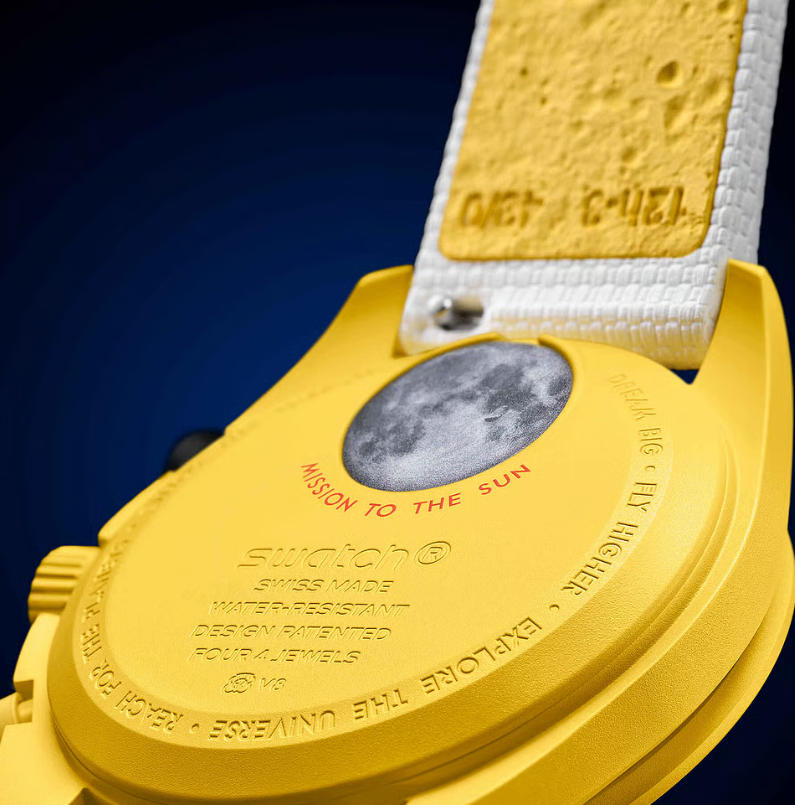
The standard Mission to the Sun is bright, cheerful and deliberately difficult to ignore. Its yellow Bioceramic case is one of the louder designs in the original MoonSwatch family, so Swatch did not need to do much to make the eclipse edition stand apart. The most noticeable change is the black Bioceramic chronograph pusher at 2 o’clock. Against the yellow case it looks almost like a shadow passing across the watch, which is exactly the point. Swatch describes it as a reference to the moment when the Moon briefly blocks the Sun during a total solar eclipse. It is a simple idea, but I think it works better than adding another graphic to the dial would have done. The contrast is visible without turning the watch into a completely different model. For collectors who enjoy small MoonSwatch design changes with a clear story behind them, that single black pusher is probably the detail that matters most. Turn the watch over and there is another change that is easier to miss. The battery cover carries a New Moon design, referring to the lunar phase required for a solar eclipse to occur. It is not something anyone else will notice while the watch is on your wrist, but that is partly why I like it. The front tells the obvious story; the back keeps the quieter part for the owner.
It Still Feels Like a MoonSwatch, Not a New Watch
It is worth being clear about what this release is and what it is not. Mission to the Sun – Solar Eclipse is not a new branch of the MoonSwatch family and it does not introduce a radically different case or dial architecture. The familiar MoonSwatch character remains intact. The watch continues to use Swatch’s Bioceramic material, a composite made from ceramic and biosourced material derived from castor oil. More importantly, its overall shape still borrows heavily from the Omega Speedmaster Moonwatch, particularly through the chronograph layout, twisted-lug-inspired case profile and tachymeter-style visual language. That connection is one reason MoonSwatch releases continue to attract attention well beyond normal Swatch buyers. They sit in an unusual space: far more playful and accessible than an Omega Speedmaster, yet instantly recognisable because of the design that inspired them. For readers who follow Omega replica watches in the UK, the release is interesting for much the same reason. Details such as bezel proportions, dial layout, pushers and case shape show how strongly a few familiar Speedmaster cues can define the personality of a watch. Omega-first.co.uk covers that wider replica and Omega-inspired watch market independently and is not affiliated with Omega or Swatch.
Why Spain Was the Whole Point
The unusual part of the Solar Eclipse release was not really the watch itself. It was how difficult Swatch deliberately made it to buy. The model was offered only on 12 August 2026 and only in Spain. Online orders were handled through the Spanish Swatch website, while physical availability included selected stores in Bilbao, Ibiza and Valencia. Swatch also sent its Rolling Planet installation through León during the day. For a UK collector, that meant this was not simply another MoonSwatch you could decide to pick up locally a few weeks later. The geographical restriction was part of the idea. The watch appeared where the eclipse was being celebrated and disappeared with the event. That makes the release feel closer to a souvenir of a specific moment than a normal catalogue addition. I would stop short of calling it one of the rarest MoonSwatches ever made, because Swatch has not publicly attached a production number to the model. What can be said with confidence is that one-day MoonSwatch availability limited entirely to Spain creates a very different kind of scarcity from a normal release.

The Speedmaster Connection Still Matters
The MoonSwatch story has always depended on more than colour. Beneath all the playful names and planetary themes is the outline of one of the most recognisable chronographs ever made. The Speedmaster influence is why even a small alteration such as a black pusher becomes noticeable. When the basic architecture is already familiar, tiny changes have more visual weight. Readers interested in how that shape is interpreted across different watches can also explore our Omega Speedmaster replica watches section, where we look at different Speedmaster-inspired references and the details that separate one version from another. That is a more useful way to think about the Solar Eclipse edition than simply asking whether it looks dramatically different. It does not. Instead, it demonstrates how Swatch can keep returning to the same underlying Speedmaster-inspired format and still give individual releases their own character.
Is the Solar Eclipse Edition Actually More Interesting?
This will probably depend on what you want from a MoonSwatch. If you prefer releases that look substantially different from something already in the collection, this one may feel conservative. The yellow Mission to the Sun already existed, and replacing one pusher while changing the battery cover is hardly a technical reinvention. But if you enjoy watches because of the circumstances surrounding them, the Solar Eclipse version makes considerably more sense. Its appeal comes from the fact that the physical watch, the place of sale and the astronomical event were all tied together for a single day. That kind of storytelling is difficult to reproduce later. You could make another yellow MoonSwatch with a black button, but it would not have quite the same connection to 12 August 2026. For me, that is what separates this release from some of the more obvious limited-colour exercises. The appeal of the Solar Eclipse MoonSwatch is in its context rather than its specifications. You do not need an entirely new movement or case to create a memorable watch when the story around it is strong enough.

A Release Built Around a Moment
Mission to the Sun – Solar Eclipse is probably not the MoonSwatch to choose if your priority is maximum visual novelty. Put it next to the regular Mission to the Sun and the family resemblance is immediate. Look at it as an event watch, however, and the idea becomes much more convincing. The black pusher represents the brief darkness of totality. The New Moon battery cover carries the astronomical reference onto the back. The Spanish-only, one-day release connects the watch directly to the place and date of the eclipse. None of those details is particularly complicated on its own, but together they give the watch a reason to exist beyond another colour variation. For UK MoonSwatch and Speedmaster followers, it is also a reminder that some of the most enjoyable releases are not necessarily the ones with the longest specification sheets. Sometimes a familiar Speedmaster-inspired chronograph with one carefully chosen detail can tell a better story than a much more ambitious redesign.